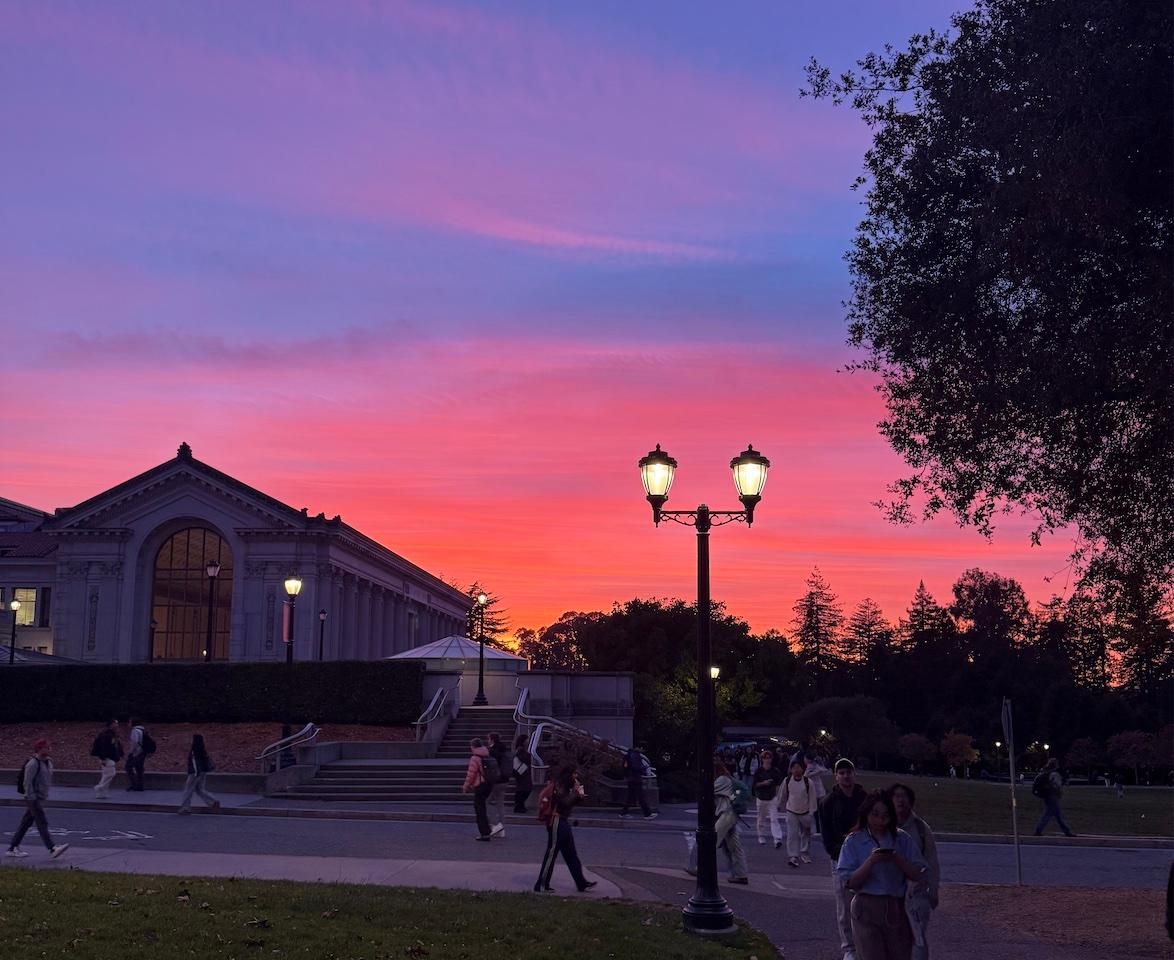
my mind, in just the last day or two, has calmed substantially compared to the chaotic mess of the past few weeks. in any era of turmoil, steady calm is a cooling, healing relief. the most fascinating analysis of my plight, if you will, is that nothing in my immediate physical world has changed between the last few days and the past few weeks. my schedule is the same, as are my responsibilities. in fact, i like to think that the only thing that has truly shifted is my fundamental understanding of panic, and the peace that has arrived with it. which is weird, to say the least. panic? of all things?
seasons of uncertainty are never simple. senior fall of college has my future dangling on a precarious thread, just out of reach, and everyone knows it. any different day and my mind is compelled to pick one thing over another: industry over grad school. big tech over startups. employment versus running away and living on an island filled with mango trees. my mind is as malleable as the jelly capybara toy that sits on the desk where i write, and it is subject to the whispers of anything and everything around it: a neighboring professor may convince me one day that grad school is a good idea. an industry friend might convince me the next day that the strict 9–5 is the best thing to have ever happened to mankind. i appreciate the constant reassurances that it is okay to not know, that any limitations are self-imposed, that everything will work out in the end.
i’ve come to believe that most of these subtle, unverifiable facts of life are inevitably true. everything usually does have a way of working out, even though the world and its outcomes are inherently random. rejection is often re-direction, even if that’s certainly no law of physics. but what has fascinated me most in recent days is not the common wise-man-phrases i’ve stated above, but the less obvious phenomena i detail below:
one of my closest friends and i have found ourselves in an interesting dilemma. while i cannot speak for her, i can speak for myself and account for the parallels that have occurred between our shared experiences. our quandary-at-hand is the blossoming of cynicism, a phenomenon that has stripped away much of our joy and wonder in recent months. we have lost the energy to do things we once pursued with love and, dare-i-say, passion.
i write in a previous blog post about foregoing all of my technical classes this semester, of turning fall 2026 into a safe space (minus the woes of post-grad applications, of course). one would think that that would solve most of the qualms i’ve had with my time here at berkeley. for reference, both of my breadths are nearly, if not totally, analog, and it has been absolutely wonderful.
taking only breadths and classes of my own interest have solved many of my problems, certainly. but it has not solved all of them. even though i don’t take programming classes anymore, i still code: when i recruit, when i conduct research, when i build any projects or run any scripts, i code. even though i’m far-removed from technical classes, it also doesn’t forbid me from interacting with technical concepts through teaching, which has always been one of my great passions. yet the fact that any of these supposedly fun and intellectual experiences pose a problem for my friend and me is in itself an intriguing commentary on the overall state-of-mind that has befallen me, and perhaps my close friend as well. computer science isn’t supposed to be stressful. it’s supposed to be fun. it’s supposed to be an intellectual exercise in logic and reasoning, a field that elicits wonder and appreciation for the grand advancements of our civilization.
and yet, days where i am excited about the field are few and far in between. some days, opening up an IDE is so panic-inducing that i cry as i’m prompting my agents, who are doing most of the work anyways while i sit idly, brain declining. it has crossed my mind once or twice that my reaction is probably not normal. other days, i’m so boosted with adrenaline (endorphins? flashes of dopamine, perhaps?) that i truly believe i can find my life’s calling and conquer the world, which i subsequently celebrate by launching twenty thousand subagents at the cost of exploding the claude account i share with my boyfriend (sorry!). in neither extreme scenario, and every scenario in between, do i give myself the grace to sit down and experience the things all of us have lost in the process of this rush we call life: patience. peace. pockets of uncounted time.
the patience to read and write and do and ponder is a rare thing nowadays. and i do not mean skimming, or summarizing with AI, or synthesizing for the purpose of producing an outcome. the space to ACTUALLY settle down and dive deep into something without strings-attached is a tremendous gift in its own right. that kind of intellectual exploration treats learning as a sacred place for meditation and thought. the scholar who enables that kind of environment for his acolytes is a rare find indeed. we greatly lack spaces to explore and ponder for the sake of it these days. comfort to grow in peace has been a variable that’s been missing from the equation for a long while.
this safe space has been so deprived from my friend and i in our nearly four years at berkeley that we have been conditioned to treat every learning assignment as a threat. to subconsciously perceive every ask and high-stakes situation as a challenge to be completed in the minimal amount of time possible, if not to save our egos, than to save our future selves from impending rejection.
i am certainly not the smartest person in most rooms. i consider myself the expert at scoring a great, fat median score on most berkeley eecs/cs exams. i am usually someone who knows significantly less than the person sitting next to me. but my friend is tremendously intelligent, someone i admire greatly. and both of us sat on the fourth floor of gateway that other day, keycards in hand, questioning ourselves profusely for feeling the way we did: why were we so tired all the time? why were we so resentful? “my freshman self would have done anything to have what i have now,” she said. “why, now that we have everything, are we so exhausted? so bitter?” i didn’t have an answer, but all i could think to do was nod in solidarity. all i wanted to do these days was crawl into a hole and never crawl back out. “what if i became a tap dancer?” she joked. “then i’ll be a singer,” i dreamed back.
the two of us had climbed the university’s eecs/cs ladder in almost every way possible. we had taken most, if not all, of the classes we really wanted to take. we had taught both lower-division intro courses and lauded upper-division machine learning courses. both of us were undergraduate researchers in hard-sought-out bair labs. we had professors we loved, peers we admired. nothing could be more exciting, and yet here we were, exhausted and bitter. i couldn’t make a walkthrough video or read about a deep learning network algorithm without feeling a welt of panic. she couldn’t begin doing research without feeling sickly dread travel up her spine. there it was again. this dread. this panic. draining our energy. ruining our lives.
burnout was the obvious culprit, we thought. maybe uncertainty about the future also played a part. we were seniors, after all. it made sense that we were tired and wary. burnout! i mused. it must be burnout!
but rest seldom helped. i won’t lie that burnout probably did play a part in all of this, but my complaints and waves of dread felt rooted in something deeper. i just wasn’t sure what. i had to carefully peel the delicate onion of our psyche to find the culprit.
“it’s the system,” my friend hypothesized. she has been thinking deeply about systems recently. not AI systems, but systems in all other respects. societal systems. educational systems. ways of thinking that have governed and shaped our views of the world, the ladders we’ve climbed, the rules we have optimized for.
i thought about her words and voiced a downstream conclusion. it wasn’t just the system, but the pressures, the rejections, and the unhealthy ways we‘ve coped with the system that have led us to our plight. we have become exceptionally jaded because it’s the only way we have been able to protect our sanity.
i liked to believe that that conclusion hit the nail for both of us.
we were both so eager as freshman, and we were rejected from most of the clubs we applied to. no biggie. we applied again and again. we were so eager as sophomores, and we were rejected from most of the research we applied to. no biggie. we applied again and again. we were somewhat eager as juniors, but every homework we attempted was made deliberately difficult, purposefully impossible to weed out the ones who didn’t deserve a place in our class. “they can take it. berkeley students are smart.” we’ve taken and taken and taken the blows, but at what cost?
every time the two of us open a homework (mind you, we have been lab partners for a long time now), the first reaction we have is fear or panic. the second reaction we have is meticulous calculation, a race against the clock. worries that we probably won’t finish in time, and ways we must squeeze out the milliseconds. now with AI access, our constant race against the clock has become even more pronounced, even more extreme. if we can one-shot task A, we can then complete task B and task C, which might then give us more compelling proof of our competency so that person D, lab F, club J, and job K won’t reject us again. we’ve optimized so much for the results--the completed homeworks, the published papers, the highly-scored exams, the lauded positions--that our mental barriers have been conditioned for speed and anticipatory rejection.
once we finally attained all that we worked for, it was too late. we’d lost all of our spark. i struggle now to even sit down and read my political econ readings in its entirety, not because of focus issues, but because i feel like i am wasting my time. i have this compulsive urge to dump everything in chatgpt, summarize its contents, and do something else in order to attain maximal results in a minimal amount of time.
once upon a time, back in 2023, my friend and i sat in li ka shing for our cs61a lectures not because we were trying to optimize for the best grades with the least amount of effort, but because we were wide-eyed and curious.
now, all we knew how to do was compartmentalize our efforts so that we could advance our agendas across multiple parallel fronts. the less time we used to achieve more? the better. “productiveness!” they say.
we entered our respective degrees as freshman with such great enthusiasm, and entered our senior year with this odd combination of numb appreciation and inexplicable mental anguish. we have become accustomed and conditioned to view everything as a threat, if not to grasp for straws at the little resources we’ve been allocated, then to protect ourselves from inevitable rejection. we’re told that we’re not qualified for X beginner course unless we already have experience. we are shown that we are undeserving of the basic decency of a prepared lecture. we are prevented from even getting a chance to take the courses we want, from even getting an accomodation for genuine extenuating circumstances.
how can anyone thrive under these preconditions, given that they aren’t in a particular subclass i deem “computer science genius?” even if we managed to get through all of these obstacles and climb to the top, how can any of us be expected to make discoveries if our first instinct is to run some convoluted time calculus, defend against some tsunami of stressful panic, and steel-up against an abundance of intellectual superiority complexes that have much far-reaching implications than any of us can individually comprehend?
in the end, i had to recognize that these were the bitter, unintended side-effects of our four-years of hard work. to understand that the dread, fear, and numb indifference my good friend and i harbored were not because of the coding tasks themselves, but because of the trauma we associated with them. it is hard to ward off 30+ months of compounded deep stress and panic in a matter of days, even after reaching the top of a mountain.
i have begun the slow, arduous process of re-wiring my brain. of chipping away at the nonstop buildup of fear and panic that has institutionalized itself within my being.
first and foremost, i’ve started by giving myself permission to take my time. to try things from scratch even though i know i’m being considerably slow and stupid in the modern era of undiluted AI access. to take pride in the process and associate it with curiosity once more, rather than panic, fear, and meticulous time calculus. no one was going to fail me for being a snail! i have begun re-wiring my brain to recognize that it’s fine if i spend hours on something that ends up fruitless, because guess what! it probably wasn’t fruitless. it just seems fruitless from the perspective of a student trying to optimize their profile so that a research lab will finally accept them, so that a job will finally acknowledge their existence, so that a paper will finally be accepted, so that someone will finally extend an olive branch and offer them a shot.
reading, actual reading, has been a great healer for my soul. no summaries. no mediums of extraction intended to speed things up. a simple diet of raw, undiluted, original texts, unconstrained by deadlines or deliverables, has done me wonders. it has been a great period of time since i have had the energy to dissect exactly how something works in detail, to ponder about exactly why an author decides to imbue certain traits into their characters, to reason through why a transformative discovery in historical technology has taken place, to laugh at the audacity of a decision made, a discovery forthcoming.
in just the past few days, giving myself time and grace to dive deep without consequences has done a great deal, not just for my actual tasks, but for other parts of my life too. i have regained the energy to incorporate a consistent exercise routine again. i have sat and written a story in one sitting for many hours, and derived nothing but joy out of the process. i have thought more about philosophy, collective ideology, human nature, aliens, poisons, extraterrestrial threats launched by superior beings, power, greed, and immortality, than i have done for the past few years combined. which, in all the peculiar ways our world works, has somehow slowly regrown my interest in tech again. it has allowed me to revisit and reconsider the questions i’ve asked in my research, to ponder about why the hypotheses i’ve posed might be interesting in the grand scheme of things.
the appetite for intellectual sustenance has slowly begun to seep back into my life. it is still in its early beginnings, a work-in-progress at best. but re-wiring my brain to approach coding, software, machine learning, and anything remotely related to computing in the same safe, curious way i’ve always approached other parts of my life has done wonders. i acknowledge that i can only ponder at the intellectual level i have attained because of my berkeley education. but i also believe that the parallel fear, resentment, avoidance, and claustrophobic anxiety my friend and i have both experienced is a byproduct of the same educational system that nurtured us. it is something that i must approach with great care.
in our season of uncertainty, foresight and awareness is something akin to medicine. the medicine for my friend and my own dilemma is not something that we can simply inject. it is an antidote that we must swallow, nurture, massage, and apply consistently over time, until our bodies are re-wired to approach our tasks with calm serenity once more. to not immediately move into fight-or-flight mode, to not immediately detect risk and turn off our brains as a survival mechanism, will take patience.
giving ourselves time, grace, and safety to explore without external panic and time calculus is nearly impossible these days. but it is also the only way i believe we can bring back our long-forgotten joys of learning.