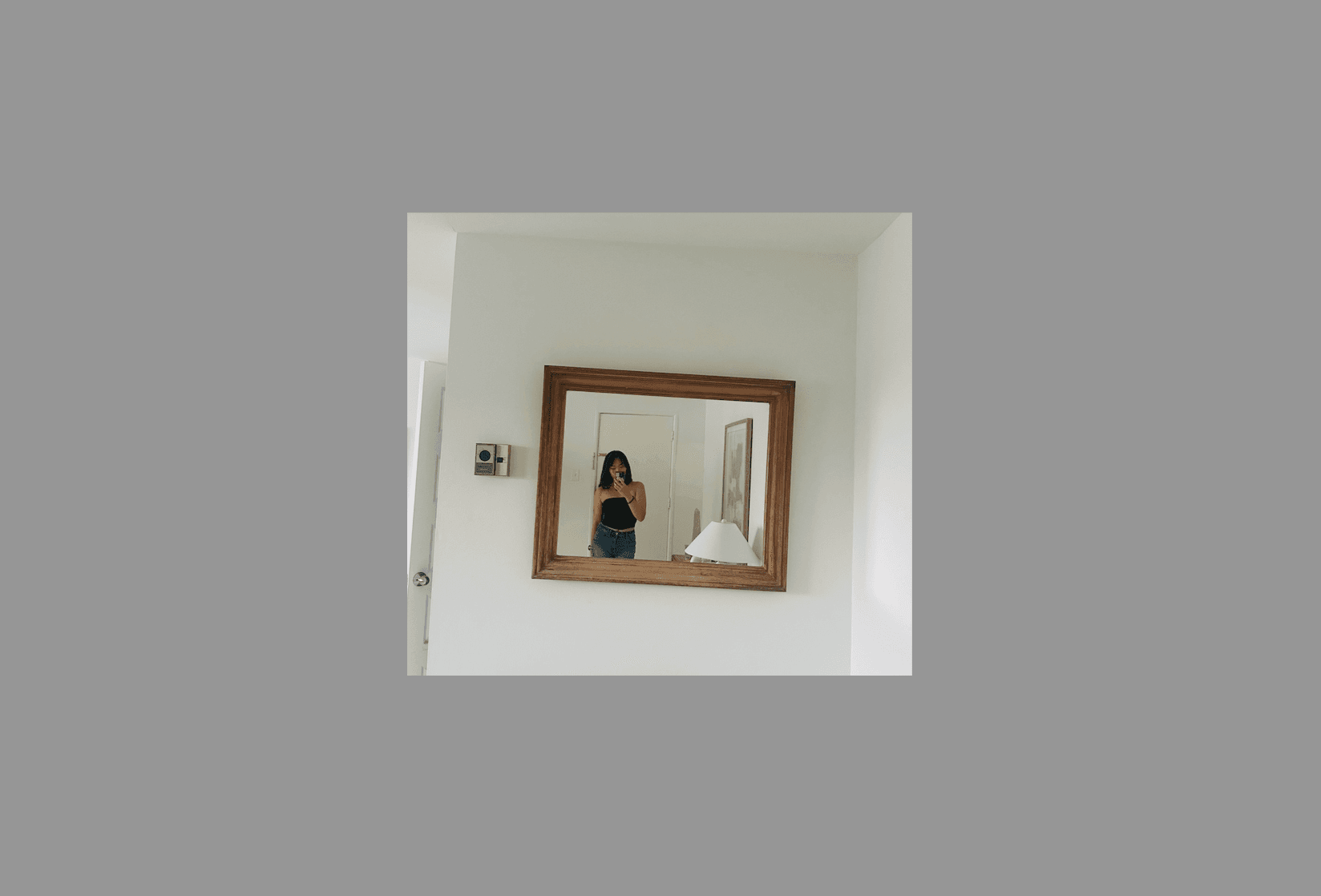
self-awareness is an odd entity to try to capture and observe.
i’ve never been the type of person to think too deeply about situations, emotions, or my reactions to them, but it has come onto my radar again and again: to be in-tune enough with one’s emotions as to not only observe them, but also adequately reason about them and evaluate their roots, is akin to having 20/20 vision.
when you’re small—and i mean, really small (like 8 or 9 years old), you think that you are the center of the world and that everything revolves around you. perhaps that’s not a fair generalization for the more well-read and reflective children of the world, but that was my experience, so i’ll assume that’s the status quo for now.
primary school really reinforces that. you are the center of your projects, your grades, your childhood skits, your dances, your sports teams. you feel this way or that about friend groups or teachers, and your actions are a consequence of your own very important feelings. you feel mortified after doing xyz, and your friends will feel this or that because of what you did.
stepping out of that self-centered construction of reality is equally difficult and eye-opening. i sometimes describe the feeling as akin to having Big Brother (1984) watch over you, except that this time, Big Brother isn’t the government; it’s your own consciousness jumping out of your body to re-evaluate what you’re doing and why you’re doing them.
i realized i was a chronic people-pleaser for the first time when one of my good friends in middle school asked me why i always apologized for trivial things. “soccer players don’t say ‘i’m sorry.’” she said. as you might deduce, she was a soccer player, and i was not. she was also good at PE class, and i was stereotypically terrible. “when players make a bad play, we say ‘my bad,’ because honestly…what is there to be sorry about?”
self-awareness is interesting because it breaks you down into a series of intents and consequences. i never got over the fear of confrontation until college, when i finally began setting boundaries and putting up walls against people that only leeched and never gave. i only realized how much i suffered from trying to maintain peace and happiness (intent) when i realized how much of a doormat i’d become at my own expense (consequence).
looking at reality from Big-Brother mode showed me that niceness was not empathy. it was debilitating. self-awareness, on the other hand, was freeing. i like to think that without knowing oneself (nosce te ipsum), and thus knowing others (nosce alios), there is no basis for self-reflection nor empathy. and a solid base for empathy seems like a sine qua non for human dignity.
about a week or two ago, i was interviewed by my high school for a project they were doing on alumni at different universities. i was asked to talk about berkeley: about why i liked it, why i didn’t, and what applicants should know about attending the school. yet again, i was drawn back to this intangible feeling that cal made me more aware of everything, in a way that is difficult to place into words.
some people operate with this air of self-importance that you detect the minute they glance at you or open their mouth to speak. i almost think that the current systems in place only inflate this kind of egotistical behavior. while i was certainly not going to say that in a video interview soon-to-be plastered on the website of my alma mater, i suppose it’s quite fitting to state here:
we are taught, in many ways, to inflate ourselves in every way possible. to curate ourselves excessively, and to make ourselves the center of the world in a way that is acceptable to the public eye. the university application process certainly perpetuates it, as does the working world. excessive college application essays probably reflect this status quo the best. reflect on a personal experience that will make you a valuable addition to [x] college. talk about an issue that’s important to you, where someone held the opposing view. how will you change the world with your [x] education?
ha! as if the people reading those essays care. as if the millions of exemplar essays online actually provide any benefit, or guidance, to help you craft a genuine personal narrative. they pretend that they are thoroughly evaluating the kind of person you are, but we are all but a mere one-minute skim amidst the thousands of others trying to shoehorn their way into validation university. i know it sounds depressing, but if i were to walk back into my senior year shoes, i like to think that that kind of knowledge is empowering: it means that you can write whatever resonates with you, as long as it answers the prompt, instead of what others are telling you to write. because in the end, who the fu— cares?
self-awareness often arises from structural change. i think that one of the greatest benefits of attending a large public university is humility. i tried bringing that point across in my alma mater’s interview project, but i’m unfortunately far more competent at writing than speaking—so here’s my best shot: being 1 out of 30,000 other undergrads on a college campus certainly makes for a great slap-in-the-face. you look inwardly at yourself and realize that you mean nothing—in the best way possible.
when i went to a small, competitive public high school where everyone knew everyone else, i thought that every decision i made was a great force in the cosmos of society. i watched people fight for hierarchical respect in journalism via who could scream at their staffers the loudest (also their peers, might i say), who could churn the most bylines, who could act the most cocky—and, should all of those fail, who could gain the most respect by demeaning or underhandedly deceiving others. i was subjected to equivalent ire. quiet observation and kindness were equated to a weak lack of personality. it was as if we were all worms in a small pot, fighting for the few scraps that would allow us to ascend out of that pot…which we had, comedically, created ourselves. the system just placed the lid on top and sealed it shut.
three years ago, i stepped into a 1,000-person lecture hall, and that pot crushed into pieces. or i accidentally escaped…who knows? here i was, at one of the great academic powerhouses of the world, and yet that single-handed, self-important aura that brought so much social status in secondary school was gone. i was not taught that i was a special “chosen one.” not in the slightest.
on the contrary, i was told that sure—admits were important, whatever. but i was not pampered to believe that i was to be a great leader of tomorrow, uniquely handpicked to change the world. i suppose i could be a good leader, you know, just like he could, or she could, or they could, or you could. but that wasn't the important part. what i was offered, instead, was the chance to learn—to meet people of all life experiences, many of whom had experiences that greatly outweighed the richness of my own, and understand them. i was taught to band together and combat the institutional inefficiencies and resource constraints that taught me more than any A+ handed on a silver platter ever could. under the eye of the greats, nobel prize winners casually walking around and crazy accomplished people and whatnot, i was nothing. humbled, in a way few others can.
for the first time, i became aware that all this title-driven larping and egoism was absolute bs. that my perceptions were simply a product of the input i received. there is this saying that you become the average of the five closest people around you. that oversimplifies things, of course, but it also rings true to a certain extent. when you hang out with a certain friend enough, you begin internalizing the world in a way that aligns better with theirs. when you spend time with a significant other, you unconsciously begin to pick up their mannerisms. in a huge public university like mine, i began to pick up just how insignificant i was in the greater narrative.
self-awareness creates this space to not only feel, but decipher what we are feeling. i suppose that we are biologically programmed to always be thinking about ourselves. how we feel first. how we’ve been wronged. but that is all centered around me, me, me. in fact, i thought i had it all figured out: i was no doormat anymore. i was to be kind but stand my own ground. if i was right, i was not to say sorry. why should i? why should anyone owe it to anyone else, unless some action genuinely required an apology?
what a black-and-white vision that was! i thought i knew what empathy was, until i met my boyfriend and let him into my life. now, there was rarely a wrong and a right. how could one be right and wrong at the same time? the mere conundrum made things impossible. stubbornness was not the answer anymore, because now there wasn’t just me to reconcile with. there was him, too. and we could both be right, and both be wrong, at the same time. both and neither be at fault.
what kind of self-awareness was this now? i started out with, you, you, you, and then prioritized me, me, me… and now i had to figure out how to prioritize us, us, us. do i have it figured out now? heavens no...
in a world with me, and you, and everyone else, everything is an absolute, swirling mess. stepping out of my head and into omniscient Big-Brother mode means stripping my emotions bare to understand what i’m feeling, and why i‘m feeling, and whether what i’m feeling is something i can change, or something i can learn from, or something i should simply let go.
because the truth of the fact is: even in this swirly, messy world, no one cares. and i don’t mean that in a negative way, nor am i saying that in a literal sense. (like yes, of course your family, your loved ones, your friends all care). what i mean to say is that none of us are so important, or so great and grand, as to warrant the momentous weight we put on others’ perceptions of ourselves. we dwell on posts and wordings and narratives and over-analyze for hours, thinking about how other people will judge, when in reality, most people are probably going to glance at our posts for two seconds max before moving on with their lives. in fact, they’re probably going round-and-round about their own metaphorical online and physical presences.
we can live lighter and happier lives knowing that the actions of most people, especially when directed maliciously at ourselves, are a result of their own biases, their own worldviews, and their own insecurities. of course, we should always advocate for ourselves. but how others reflect negatively on you or me is simply a matter of their own limited personal perceptions.
all we can do is try to know ourselves. to know that we are all very flawed, and to better ourselves because of it. for we’re all but a small speck in the grander universe, with little inherent power over the person next door.
there’s no need for ego or fear of judgement. as the ancient greeks said: nosce te ipsum. let that set us free.