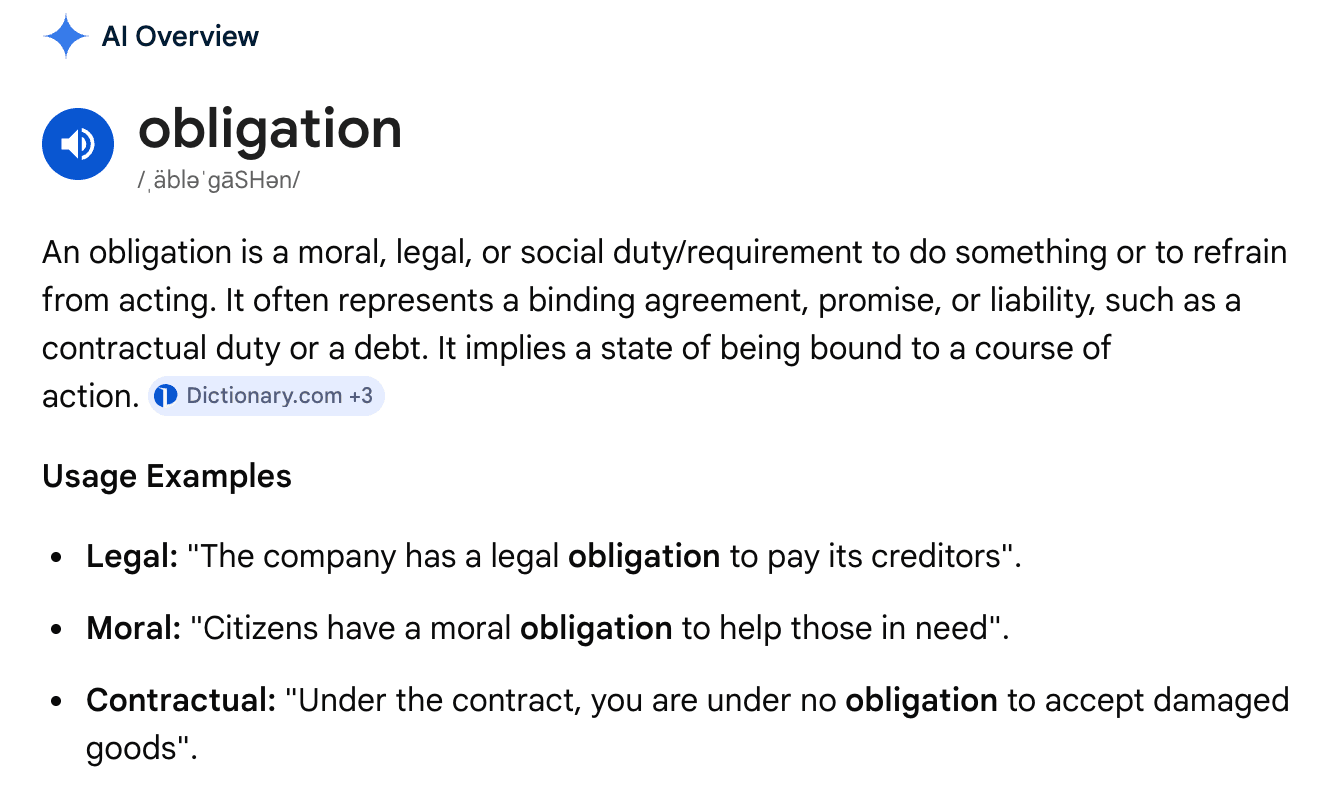
Obligation is a funny word. AI is also a funny word. Now imagine Google replacing its concise, well-loved dictionary definitions with bullet-pointed, AI slop that makes you feel like you're reading yet another ChatGPT dump of what obligation should be.
There really is no imagining needed here. The reality of AI Overviews sits right there in plain sight, per my screenshot above. In fact, by the recent trend of things, the easy solution to any semi-difficult problem seems to always lie in two letters, repeated many times for maximum effect:
AI! AI! AI!
It's comical at this point, because I'm in this period of college where most people are at a crossroads: Namely, what should one do post-grad? While I am trying my best to be as imaginative and optimistic as possible about what lies in store, the tree of choices I have for my foreseeable future reeks of mildew: every possible branch I may choose to walk across, save for a very few, leads to the same rotten core of obligation, AI, obligation, AI, obligation. If you're a fan of The Midnight Library by Matt Haig, you may understand my reference.
Obligation: "A Contractual Duty"
All my life, I've felt this obligation—this intrinsic duty, one could say—to complete the rituals that I know are good for me. Study hard in high school because it is good for me. Study (maybe a little less) hard in college because it is good for me. Study things I might not even enjoy that much, because it is good for me in the long run and I'll appreciate my former self for doing so. Choose things that are advantageous, stable, and strategic. Choose things that seem like they would be good for my long-term development. Along the way, I may develop some genuinely useful skills, learn some wonderful things, meet some exceptional mentors, explore pockets of intellectual puzzles that actually interest me, and make some great friends. I may even convince myself that I am happy with what I'm pursuing.
But under all of this optimism and dedication (and perhaps a little bit of gaslighting as a means of self-preservation) lies this inky realization that's slowly seeped in through the cracks:
Even though I'm a CS major, I don't particularly seem to care about coding. In fact, I kind of hate it. It's, weirdly enough, been made more and more evident as the end of college creeps closer and, believe it or not, as AI tools advance.
I very much admire those who, from the bottom-of-their-heart, program in their free time because it nourishes their soul. I also empathize with those who relate when I say: I don't resonate with where tech is heading. In fact, I probably despise it more than I am excited about it.
Although now that I think more about it, "despise" doesn't seem like a completely accurate descriptor either. If I were really to rank my overall thoughts with some score and see which descriptor's semantic score matches the best on the basis of cosine similarity, I would say that my indifference towards tech is what seems to triumph over all other descriptors.
Indifference is probably what scares me the most, too. Is it weird that I'm more happy than pessimistic that AI can, very soon, replace most of my plausible coding jobs? Herd in the robots, please!
Obligation: "A Binding Promise"
I am privileged to study computing at one of the best universities in the world for the subject, and I feel so lucky to have been exposed to these myriads of ideas and paradigms of thinking that have, with no exaggeration at all, totally reshaped my perspective on life. I think every person deserves an education like that: One that forces them to think, re-think, and re-shape everything they thought they knew. UC Berkeley is that place. The EECS and CDSS departments are that place. There's no better place to question what mechanisms work, how they work, and why they work, than here. The people that I have met and chosen to keep in my life during this time frame represent all that is happy and wonderful about computing at Cal. Some of my closest friends in the world are a result of this program, and their achievements, mindsets, and perhaps most importantly—characters—are things that I am in awe of everyday.
The only lack of love I harbor as I'm writing this at the moment involves my future—in other words, where I actually see myself heading as I consider options for my post-grad life. I made a promise to myself, when I entered college, that I would put myself out there and take advantage of what makes Berkeley, well, Berkeley. Academics! Research! Computing! Education! I think for the most part, I have done a satisfactory job at that. Cal's CS program is the best in the nation, and here I am, gulping it all down like a greedy little kid with a cup of cherry-flavored icee from a 7-11 gas station.
What makes this whole situation contradictory, however, is that whenever I'm asked about future possibilities, conditioned upon my current computing pursuits, I'm always retreating far, far away. This magnetic force pushing me away from what I "should" be excited about—the three pillars of post-grad life that involve industry(!) or research(!) or startups(!)—has been increasing for a few semesters now. I told many of my friends last semester that I was taking a "break" from the major and CS altogether. While that didn't materialize, it is quite the declaration for anyone to make, I think, when computing is the core of your college identity.
Obligation: "A Debt"
My PhD mentor commented to me the other day, as I was describing my extracurriculars (or perhaps my lack of engagement with many of them), that I seemed to be retiring from everything. Clubs? I'm retired. CS Programs? Running? I'm retired. Other things? Yeah, I think I'm retired from those as well. I'm not even a senior, yet I have become somewhat of a recluse in those aspects. Similarly, when I asked a group of computer science PhD students in my lab about why they pursued a PhD, I realized that I was more intent on figuring out whether they had time to think about other things outside of their PhD, rather than the nature of their intellectual life as a PhD student itself.
I suppose that because I've felt this debt to myself—all this time—to finish what I've started, (my major, my course of study, my everything), that I ought to see it through. Which I will. Certainly. I've operated for all these years on this mindset that I should trust the dividends, even when my current pursuits don't necessarily align with my pure interests.
But all this intrinsic trust has somewhat changed with the introduction of—and one would be surprised to hear me say it—AI tools. The better that AI tools get at coding, ideation, and system design, the more I lose interest in coding and creating with tech. It feels, oddly, like an inverse relationship. Like the minute I realize I'm not needed, or perhaps less needed, I'm excited to bounce. Perhaps part of it stems from my laziness. But more of it seems to stem from my intrinsic interest (or lack thereof) in my degree.
Although this is not to say that I have totally lost all feeling for tech. Where there is indifference in some areas there is also visible frustration in others. Some pursuits that I see people trying these days—creating better AI art generators, creating better AI writers, creating better AI musicians — madden me to no end. Why, when there is so much space for more important things, like AI to discover new drugs that may save people, or AI tools that save energy and time, or AI-powered prosthetics for people who have lost motor function, do people feel the need to pool their efforts toward training AI models that excel at replacing what make us uniquely human?
For example, why try to make AI better at creative writing? Isn't the whole point of creative writing to tell stories, which is a uniquely human thing to do? Pursuits like these, which in my opinion are empty attempts at replacing the fundamental soul of human life, culture, and the arts, totally baffle me. Especially as their popularity rise, so many frontier labs are trying to finetune their models to generate better creative writing or human-like art. And my question is, literally, why?
Meanwhile, I often sit here and wonder, why do I feel so obliged to pursue industry, or research, or startups? There really is no obligation to do any of the above. No one is forcing me to pursue either three avenues as my career, nor stay in this field at all post-grad. Yet with my computer science college degree slowly finishing up, I feel oddly obliged to do so. Why do I continue to stick with things that I don't resonate with? Why do I allow this surge of contempt at the thought of coding or prompting Claude all day to rise like bile up my throat, yet feel simultaneously trapped in a path that offers better pay, better benefits, and a better life than most of my alternatives?
It's a dilemma that I'm struggling to comprehend, this "obligation" to go into the three cornerstones of computer science post-grad jobs. If one really thinks about it, this whole situation is less of an extrinsic obligation, and more of an intrinsic obligement. I simply feel obliged to make use of what I've been studying all these years, which, when all is said and done, is just a feeling. I have no concrete obligation. I don't owe anyone anything.
In that case, if I don't necessarily need to commit to any one (or three) fixed futures that all CS post-grads seem to gravitate towards, why do I still feel so trapped?
I don't know. Perhaps clarity will come with time.